

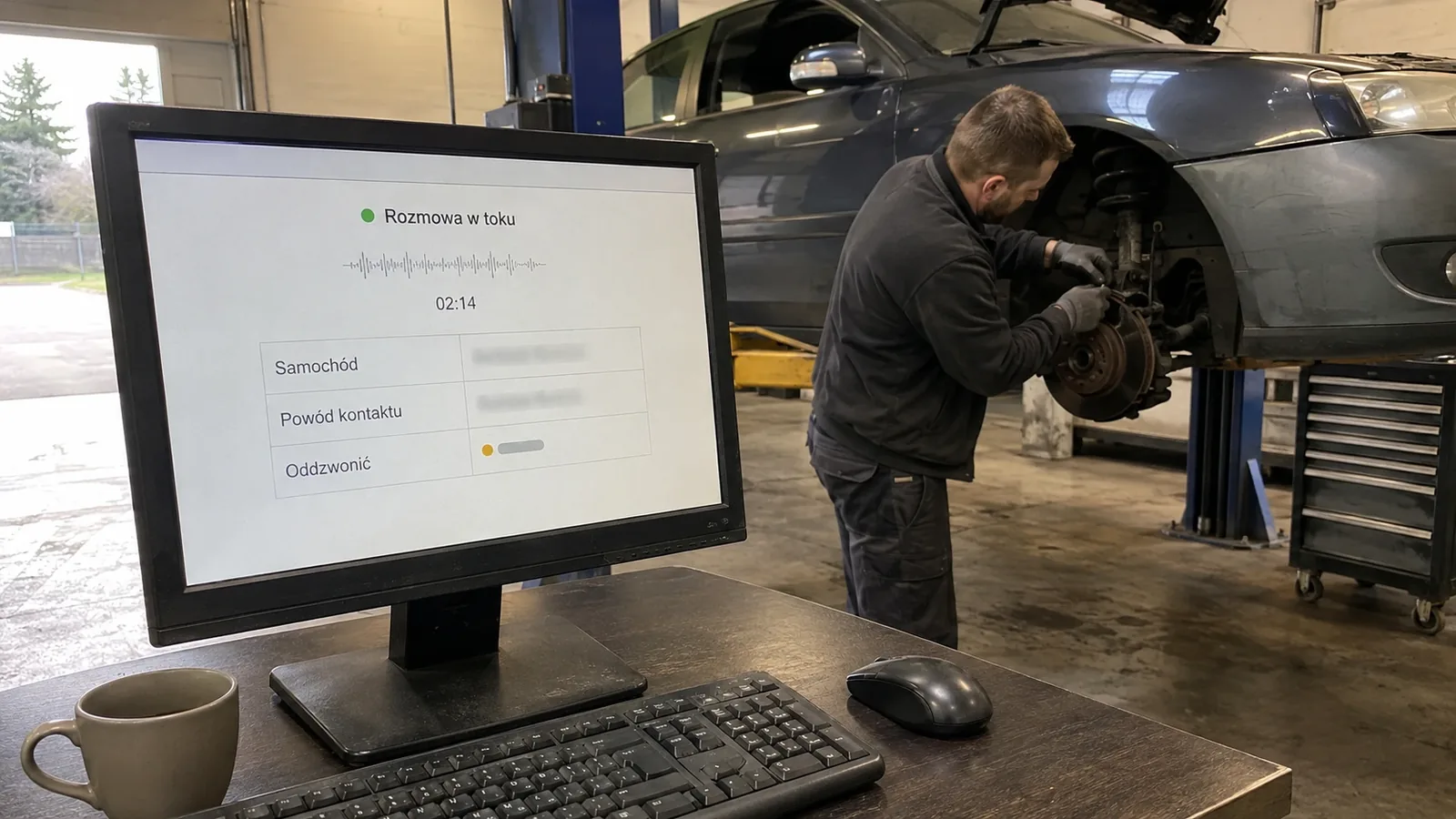
A bot that answers workshop calls sounds like a simple solution: the mechanic keeps working while the customer explains their issue. In practice, everything depends on what the bot is supposed to do.
If its task is to take a request and prepare a short summary, it can genuinely ease the team's workload. If it is expected to diagnose vehicles, quote prices and handle complaints, it soon becomes another obstacle.
Rather than asking whether a bot sounds modern, check whether the employee receives information they can act on after the call.
Not every automated phone system is an AI bot
| Solution | What it does | Main limitation |
|---|---|---|
| Phone menu | Asks the caller to select a number and routes the call | Does not understand requests outside the predefined options |
| Voicemail | Records the customer's message | Cannot ask for a missing registration number or appointment date |
| Scripted voicebot | Asks predefined questions and saves the answers | Gets lost if the customer changes the subject or answers in a different order |
| Conversational AI assistant | Understands the customer's own words and can ask for missing information | Works only within the scope it has been prepared for |
The “AI” label alone does not tell you whether a solution suits a workshop. What matters is the scope of the conversation, the quality of the summary and how quickly it can hand an issue to a person.
Where a bot helps and where it gets in the way
| A bot helps when it… | A bot gets in the way when it… |
|---|---|
| Takes appointment requests and collects vehicle details | Promises a repair time without diagnosis or an availability check |
| Records requests after hours | Gives the customer no way to speak to an employee |
| Prepares context before a callback | Repeats questions the customer has already answered |
| Explains opening hours and vehicle check-in procedures | Tries to handle a complaint or a cost dispute |
A good bot does not try to resolve every issue. It should recognise when collecting information is enough and when an employee needs to contact the customer.
Not every customer is ready to tell a bot the entire repair history straight away. Some prefer simply to request contact with the workshop. Others give a registration number, briefly describe the problem or agree to have their request recorded. That is enough for the employee to call back with basic context rather than start from scratch.
The customer must know they are speaking to AI
A bot should not pretend to be a person. A short introduction immediately explains who the caller is speaking to:
Hello, this is the automated PilotGo Assistant at Auto Serwis. I can record your request and pass on a request for a mechanic to contact you.
Article 50(1) of the EU AI Act provides that, in principle, a person interacting with such a system should be informed that they are interacting with AI, unless this is obvious from the circumstances. Regulation text: Regulation (EU) 2024/1689: Artificial Intelligence Act (EUR-Lex).
An AI disclosure does not replace a notice about recording, transcription and personal data processing. The workshop should separately establish the legal basis for processing, who has access to recordings and how long they are retained.
A bot should not diagnose a vehicle over the phone either. It can ask when a symptom occurs and whether the vehicle is immobilised. If the situation may be dangerous, a person must take over according to the workshop's procedure.
Employees need a summary, not another recording to listen to
An employee does not need the full transcript. A short summary is enough: who called, which vehicle it concerns, what was agreed and whether a callback is needed. If the bot interrupted the conversation, the summary should state which question it got stuck on and what the customer expects from the workshop.
The mechanic can then avoid opening with “Please explain everything again”. They can immediately confirm they are calling about a particular vehicle and problem.
The most important test is simple. If the customer has to repeat the entire story after speaking to the bot, the automated system has not reduced the workshop's workload.
How to test a bot before launch
One ideal demonstration call is not enough. Before launch, run four tests:
- The customer gives the make, model and registration number in one sentence, and the bot does not ask for them again.
- The customer changes the appointment date during the call, and the summary retains the final decision.
- The call takes place in noise, and the bot asks for repetition instead of treating incorrect information as certain.
- The customer raises a complaint or asks for a person, and the system ends the automated script.
After launch, regularly review unsuccessful calls. The most useful lessons come from points where the customer repeats themselves, hangs up or asks for an employee.
A bot, workshop software and PilotGo
Conventional workshop software organises repair jobs, the calendar, vehicle history, stock or invoices. A bot works earlier, during the first contact with the customer. It does not replace an estimate, stock management or the mechanic's decision.
PilotGo combines a call record, transcription, summary and appointment creation based on the agreed details. It integrates with Motowarsztat, and further integrations are planned.
A bot is real help if the workshop receives complete information after the call and can take the next step without questioning the customer again. It is merely a marketing add-on if it knows a few impressive phrases but cannot hand the issue to a person.
Learn more on the workshop software page with call history.